



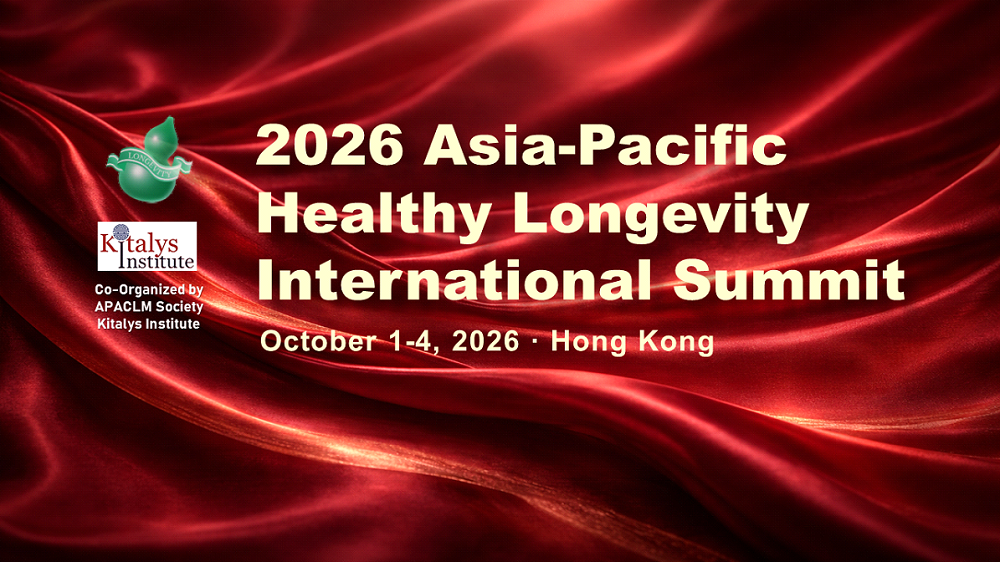
The Asia-Pacific Longevity Medicine Society (APLMS), in a strategic partnership with The Kitalys Institute, has officially announced that Hong Kong will serve as the host city for the 2026 Asia-Pacific Healthy Longevity International Summit (APAC-LMIS). Scheduled to take place from October 1 to October 4, 2026, at the Hopewell Hotel, this landmark event is poised to become a pivotal gathering for the global longevity sector. The summit arrives at a critical juncture as nations across the Asia-Pacific region grapple with some of the fastest-aging populations in human history, necessitating a fundamental shift in healthcare delivery, economic planning, and regulatory frameworks.
The 2026 summit is expected to draw more than 2,000 delegates, including world-renowned scientists, healthcare practitioners, biotechnology executives, venture capitalists, and high-level policymakers. By convening these diverse stakeholders, the organizers aim to bridge the gap between laboratory-based geroscience and the practical application of longevity medicine in clinical settings. The choice of Hong Kong as the venue underscores the city’s growing reputation as a premier hub for biotechnology and its strategic position within the Greater Bay Area, a region increasingly focused on high-tech healthcare solutions.
A Four-Day Roadmap for the Longevity Revolution
The structure of the 2026 APAC-LMIS is designed to move the needle from theoretical discourse to tangible implementation. The four-day event is divided into two distinct phases: a pre-summit program focusing on specialized training and recognition, followed by a main summit dedicated to cross-sector collaboration.
The pre-summit programs, taking place on October 1 and 2, are tailored for professionals at the forefront of the field. A primary highlight will be the presentation of the Global Top 10 Longevity Breakthrough Awards. These awards are intended to identify and celebrate the most promising scientific and technological advancements that have the potential to significantly extend human healthspan. Furthermore, the pre-summit will offer executive training modules specifically designed for leaders of longevity clinics. As these specialized medical facilities emerge globally, there is a pressing need for standardized protocols, ethical guidelines, and business models that ensure both efficacy and safety.
The main summit, spanning October 3 and 4, will operate under the theme “From Vision to Action in Healthy Longevity.” This phase of the event will feature high-level plenary sessions and panel discussions focused on defining next-generation standards for the industry. Key topics will include the integration of artificial intelligence in geriatric care, the development of biomarkers for biological age testing, and the creation of investment pathways that can sustain long-term research and development in the geroscience sector.
The Demographic Imperative: Why the Asia-Pacific Region?
The urgency of the 2026 summit is highlighted by stark demographic data. According to the United Nations, the Asia-Pacific region is home to over 60% of the world’s population aged 60 and older. By 2050, it is projected that one in four people in the region will be over the age of 60. This demographic shift presents unprecedented challenges to traditional healthcare systems, which were largely designed to treat acute infectious diseases rather than the chronic, degenerative conditions associated with aging.
Countries such as Japan, South Korea, and Singapore, as well as the Hong Kong Special Administrative Region, currently report some of the highest life expectancies in the world. However, a significant gap remains between life expectancy (the total number of years lived) and healthspan (the number of years lived in good health). The APAC-LMIS aims to address this "longevity gap" by promoting interventions that prevent the onset of age-related diseases, thereby reducing the economic burden on states and improving the quality of life for millions of elderly citizens.
Longevity Clinics: The Front Line of Clinical Translation
A central pillar of the 2026 summit will be the role of longevity clinics as the primary vehicle for clinical translation. Unlike traditional hospitals that focus on reactive care, longevity clinics are designed to be proactive and preventive. They utilize a combination of geroscience-informed therapeutics, precision nutrition, and advanced diagnostic tools to manage the aging process at a cellular level.
The summit will explore how these clinics can be scaled globally. Discussion points will include the use of AI-driven systems to analyze vast amounts of patient data, enabling doctors to provide highly personalized health interventions. Furthermore, the integration of digital health platforms—such as wearable technology that monitors physiological markers in real-time—is expected to be a major focus. Organizers believe that by establishing a robust network of longevity clinics, the medical community can move toward a model of "lifestyle medicine" that is both scientifically rigorous and accessible to the broader public.
Strengthening the Regulatory and Legislative Landscape
One of the most significant hurdles in the longevity field is the lack of standardized regulatory pathways for anti-aging interventions. Current regulatory bodies, such as the U.S. Food and Drug Administration (FDA) and similar agencies in Asia, typically approve drugs for specific diseases. However, aging itself is not currently classified as a "disease" by most health authorities, making it difficult for companies to gain approval for therapies that target the underlying biology of aging.
The Kitalys Institute, a co-organizer of the summit, has been a leading voice in advocating for regulatory reform. The institute has proposed the THRIVE Act, a piece of draft legislation designed to establish an optional regulatory pathway for drugs, devices, and supplements that demonstrate an ability to increase healthspan. At the 2026 summit, expert-led sessions will delve into these regulatory frameworks, seeking to build a consensus among international regulators. The goal is to create a tiered evidence system that provides incentives for innovation while maintaining rigorous safety standards.
Profiles of the Organizers: APLMS and Kitalys
The Asia-Pacific Longevity Medicine Society (APLMS) is a newly established, Hong Kong-registered non-profit organization that represents a coalition of medical professionals and researchers across the region. Its founding members include representatives from Mainland China, Hong Kong, Taiwan, Macau, Japan, South Korea, Singapore, Thailand, Australia, and India. This broad geographic representation ensures that the summit’s outcomes will be culturally and economically relevant to a diverse range of nations.
APLMS is led by Founding Chairman Dr. Tim Z. Shi, MD, PhD, who also serves as the Chief Representative of the GlobalMD Organization China Office. The society is governed by a nine-member Executive Board and supported by a twenty-one-member international advisory board. These advisors bring expertise in precision medicine, functional medicine, AI, and pharmaceutical development, ensuring that the society remains at the cutting edge of the field.
The Kitalys Institute, based in the United States, brings a wealth of experience in convening high-level summits. Formerly known for its "Targeting Metabesity" conferences, Kitalys has a long history of bringing together leaders from the National Institutes of Health (NIH), the FDA, and various legislative bodies. Their involvement in the 2026 summit ensures a strong link between the Asia-Pacific region and the global scientific community.
Economic Implications and the "Geroscience Dividend"
Economists increasingly speak of the "Geroscience Dividend"—the massive economic gains that could be realized by delaying the onset of age-related diseases. By extending the period of life spent in good health, societies can maintain a more productive workforce, reduce the costs associated with long-term care, and foster a "longevity economy" where older adults remain active consumers and contributors.
The 2026 APAC-LMIS will analyze the investment pathways necessary to unlock this dividend. This includes discussing how private equity and venture capital can be channeled into longevity biotech, as well as how governments can provide the infrastructure needed for clinical trials. Hong Kong’s role as a global financial center makes it an ideal location for these discussions, providing a platform where scientists can meet the capital necessary to bring their visions to life.
Expected Outcomes and Global Impact
As the world looks toward 2026, the organizers of the Asia-Pacific Healthy Longevity International Summit are clear about their mission. They are not merely hosting a conference; they are building a global platform for a medical revolution. By the end of the four-day event, delegates are expected to produce a set of white papers and policy recommendations that will guide the development of longevity medicine for the remainder of the decade.
“The future of longevity medicine is no longer just about scientific discovery—it is about implementation at scale,” the organizers stated in a joint release. “This summit is designed to connect research, clinical practice, regulation, and investment to accelerate real-world impact.”
With the support of regional partners and a growing list of international participants, the 2026 APAC-LMIS is set to redefine how the world views aging. By shifting the focus from treating the sick to maintaining the healthy, the summit promises to pave the way for a future where "living longer" is synonymous with "living better." For Hong Kong, hosting such a high-profile event reinforces its status as a world-class city capable of leading the charge in one of the most important scientific and social challenges of the 21st century.