



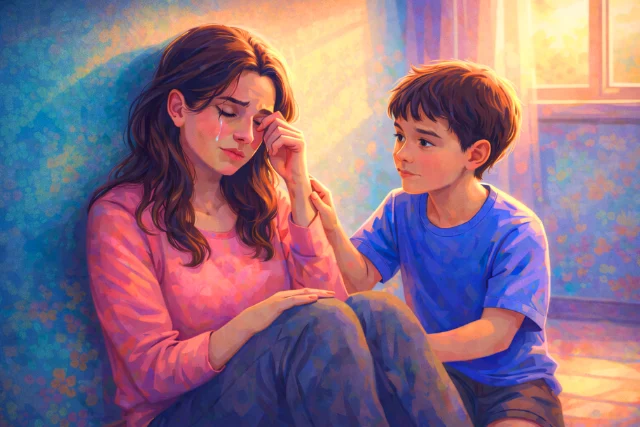
A poignant personal account from late 2021 highlights a growing understanding in contemporary parenting: the crucial role of emotional vulnerability in forging authentic family bonds. What began as a mother’s private moment of grief on Christmas morning, witnessed unexpectedly by her children, has evolved into a profound exploration of how parents’ willingness to express their full range of emotions can redefine strength and deepen intergenerational connections. This narrative offers a compelling case study on challenging long-held beliefs about shielding children from parental pain, revealing instead the transformative power of shared humanity.
The Christmas 2021 Turning Point
The pivotal moment occurred on Christmas Day, 2021. Amidst what should have been a festive and joyful atmosphere, a mother, whose children were then sixteen and twelve years old, found herself overwhelmed by a wave of grief. The source of her distress was the recurring mental health crisis of her own mother, who had once again been admitted to a psychiatric hospital. This repeated cycle of emotional chaos, which had significantly impacted the mother’s own life, culminated in a profound sense of helplessness and sorrow.
Initially, the mother attempted to conceal her distress, a practice she had maintained for years, believing it protected her children. She turned away, facing a foyer, as tears welled up. Despite her efforts, her children perceived her struggle. "Are you okay?" they asked. Her whispered "I’m fine" was contradicted by the tears streaming down her face. In an unexpected turn, both children approached her, offering a comforting hug. Their response was devoid of fear or confusion, marked only by what she described as "pure and steady love." This unsolicited act of tenderness began to dismantle the mother’s ingrained belief that her pain posed a danger to her loved ones.
The Burden of Concealed Grief: An Intergenerational Pattern
The mother’s reluctance to display her sadness stemmed from a deeply personal history. Having grown up feeling responsible for her own mother’s emotional well-being, she was determined to spare her children a similar burden. This resolve led her to meticulously guard her emotional interior, particularly when experiencing sadness. She believed she was safeguarding them from the complexities and potential instability of her own feelings, mirroring a societal tendency to equate parental stoicism with strength. This protective instinct, while well-intentioned, inadvertently created a barrier to true emotional transparency.
Studies on intergenerational trauma and emotional patterns suggest that children often internalize the emotional coping mechanisms modeled by their parents. When parents consistently suppress difficult emotions, children may learn to do the same, potentially hindering their own emotional literacy and regulation skills. The mother’s experience highlights this intricate dynamic, showing how an attempt to break a negative cycle can inadvertently perpetuate a different form of emotional distance.
Children’s Intuition: Seeing Beyond the Facade
Despite the mother’s conscious efforts to hide her sadness post-2021, her younger child, then approximately 14 years old, made a strikingly accurate observation in late 2023. "You’re the sad one," he stated, "and Dad is the mad one." This direct, unvarnished truth, though initially stinging, confirmed the mother’s dawning realization that her attempts at concealment were largely ineffective.
Child development experts consistently emphasize the remarkable intuition of children. Long before they acquire the language to articulate complex feelings, children possess an innate ability to sense emotional shifts, tension, and underlying sadness in their primary caregivers. When parents outwardly present a facade of normalcy while inwardly grappling with distress, children often perceive this incongruence. This can lead to confusion, anxiety, or even a sense of responsibility to "fix" the unseen problem, as they lack the context to understand the true source of the emotional atmosphere. The mother’s son, in his innocent yet profound statement, was simply articulating what he had already observed and felt through her demeanor, energy, occasional blank stares, and moments of withdrawal.
Shifting Paradigms: From Protection to Connection
The realization that her children were sensing her inner world without explicit communication prompted a significant shift in the mother’s approach. She understood that without context, children might personalize parental sadness, attributing it to their own actions or believing it was their duty to alleviate it. This insight aligned with psychological research indicating that providing age-appropriate truth about parental emotions, without "trauma dumping" or burdening the child with adult responsibilities, empowers children to differentiate their feelings from those of their parents. It teaches them that emotions are real, human, and not necessarily their fault.
Furthermore, the mother recognized that her consistent portrayal of herself as strong, independent, and capable, while admirable, denied her children the opportunity to see her as a multifaceted human being. By hiding what she perceived as weakness, she inadvertently suppressed the message that "I have feelings. My feelings matter too." As she began to share more of her interior world in carefully considered, age-appropriate ways, her children’s responses evolved. They became more thoughtful and considerate, not out of a sense of obligation, but from a deeper understanding and empathy for her complete self.

The Journey Towards Authentic Expression: A Chronology of Healing
The transformation was not instantaneous but a gradual process, spanning several years from 2021 to 2026. This period involved dedicated therapy, self-reflection, and a conscious effort to challenge deeply ingrained habits of emotional suppression—such as pushing feelings down, swallowing hard, or retreating to a private space to regain composure. Slowly, the mother began to allow herself to cry more freely, to let more of her authentic self be seen.
By 2026, the changes were noticeable. Her youngest son, who is autistic and shares a deep bond with her, initially reacted with awkwardness when she began expressing her tears more openly. A few months prior to the recent observations, during an episode of crying, he expressed his desire to help, saying, "I want to make you feel better, but I don’t know how." Her response was critical in establishing a new emotional boundary: "You don’t have to fix anything. Just let me be me, and I’ll let you be you. That’s the best gift we can give each other." This interaction marked a turning point, as his awkwardness softened into acceptance.
Modeling Emotional Resilience: A Son’s Perspective
Further instances cemented this evolving dynamic. After a trip to Canada, while landing in Houston, the mother found herself crying due to a profound sense of not wanting to return to a place that no longer felt like home. Without a word, her son wrapped his arms around her, holding her until her tears subsided. This silent act of comfort demonstrated his growing capacity for empathy and acceptance of her vulnerability.
However, a subsequent moment in the car offered the most profound insight. While driving, a song evoked sadness, reminding her of someone she missed. As tears flowed, she explained to her son, "I’m okay, honey. The song just reminds me of someone and makes me sad. I just need to get it out, and then I’ll be okay." Despite her lingering self-consciousness, fearing judgment, her son’s response was unexpected and deeply moving: "I wish I could cry like that," he said, adding, "You’re strong."
This statement fundamentally challenged the mother’s lifelong perception of tears as a sign of weakness. Through her son’s eyes, crying was not a failure but an act of courage and strength. This redefinition of strength underscores the powerful lessons children can absorb when parents model authentic emotional expression.
Challenging Gendered Norms of Emotion
The car conversation also opened up a more concerning revelation. Her son admitted he could no longer cry, describing the sensation as "stuck in his throat" since he was thirteen. This observation brings into sharp focus the pervasive societal conditioning, particularly for boys, that discourages the expression of sadness and tears. Many boys learn early to suppress these emotions, internalizing the message that "men don’t cry" or that emotional display is unmasculine. The mother recognized that both she and her husband had inadvertently contributed to this modeling, and that unlearning such deeply embedded norms would require conscious effort and time.
This phenomenon is widely documented in psychological literature. Traditional gender roles often pressure males to exhibit stoicism and emotional control, leading to potential long-term consequences for mental health, including difficulties in emotional regulation, increased stress, and a reluctance to seek help for emotional distress. By recognizing this pattern in her son, the mother identified an opportunity to actively counter these societal pressures within her family, promoting a healthier, more holistic understanding of emotional well-being.
Broader Implications for Parental Emotional Honesty
The mother’s journey from guardedness to vulnerability offers significant implications for contemporary parenting philosophies. For years, the prevailing wisdom often suggested that parents should maintain an unshakable front to provide a sense of security for their children. However, this narrative argues that true security is not found in parental infallibility, but in their genuine humanity.
Psychological research supports the idea that children benefit from seeing their parents navigate a full spectrum of emotions, including grief, overwhelm, and tenderness. This exposure, when handled with care and age-appropriate explanation, teaches several crucial lessons:
- Emotional Normalization: Hard feelings are a normal part of life and can be experienced without leading to catastrophe.
- Emotional Boundaries: Sadness can move through a space without becoming the child’s responsibility to fix.
- Resilience Modeling: Children learn that it is possible to experience difficult emotions, process them, and eventually feel better, demonstrating a pathway to emotional resilience.
- Deepened Connection: Vulnerability fosters intimacy. When parents allow themselves to be truly seen, it creates a deeper, more authentic connection with their children, built on mutual understanding and empathy.
- Redefining Strength: The capacity to feel, express, and process emotions, rather than suppress them, is a powerful form of strength, offering children a healthier model for their own emotional development.
In conclusion, the initial fear that parental tears might undermine a child’s sense of safety is being challenged by a growing understanding that, when held with honesty and care, such expressions can teach profound lessons. The narrative underscores that being fully human, with all its emotional complexities, is not a weakness. Instead, it is a pathway to deeper connection, empowering children to embrace their own emotional landscapes and fostering a familial environment built on genuine acceptance and understanding. The shift from pretending to "have nothing to feel" to openly acknowledging one’s inner world represents a powerful evolution in how families can truly see and support one another.