


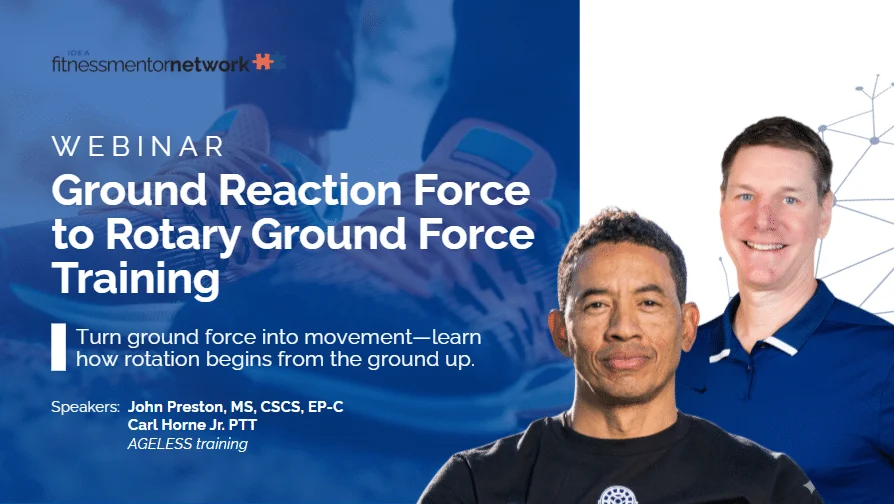
The webinar will explore the fundamental science behind force production, meticulously detailing how ground reaction force (GRF) can be effectively harnessed and manipulated. John Preston, known for his expertise in the scientific underpinnings of exercise physiology and strength conditioning, will dissect the intricate mechanics of how forces generated against the ground are translated through the human body. He will then transition into demonstrating how to specifically apply rotary ground force training to achieve multifaceted benefits, including heightened core activation, optimized kinetic chain function, and the development of stronger, more functional movement patterns crucial for both athletic prowess and everyday physical resilience.
Fitness professionals, strength and conditioning coaches, physical therapists, and performance specialists are the primary audience for this intensive session. They are expected to gain invaluable insights, practical drills, and refined coaching strategies. A core objective is to deepen their understanding of how force is not merely generated but also effectively transferred and meticulously controlled throughout the body. This comprehensive knowledge aims to empower attendees to design more intelligent, evidence-based, and ultimately more effective training programs tailored for clients across all levels of fitness and athletic ability, from rehabilitation patients to elite competitors.
Unpacking the Science: Ground Reaction Force and Its Rotary Application
At its core, Ground Reaction Force (GRF) is a fundamental biomechanical principle derived directly from Newton’s Third Law of Motion, which states that for every action, there is an equal and opposite reaction. When a foot pushes against the ground, the ground pushes back with an equal force in the opposite direction. This seemingly simple interaction is the bedrock of all human movement – from walking and running to jumping, lifting, and the complex, dynamic actions seen in sports. The magnitude and direction of GRF are critical determinants of movement efficiency, speed, power, and agility.
The traditional understanding of GRF often focuses on its vertical and horizontal components. However, the concept of "Rotary Ground Force" introduces a crucial third dimension: the rotational forces applied against and reacted by the ground. Many human movements, especially in sports, are inherently rotational. Think of a golfer’s swing, a baseball pitcher’s throw, a tennis player’s serve, or a martial artist’s kick. In each instance, powerful rotational movements originate from the ground up, with the feet pushing and twisting against the surface to generate torque that propagates through the kinetic chain.
Optimizing rotary ground force involves teaching the body to efficiently create and manage these rotational forces. This goes beyond merely pushing off the ground; it involves a sophisticated interplay of muscle activation, joint stability, and coordinated movement patterns that allow for the seamless transfer of energy from the lower body through the core and into the upper extremities. A robust and well-activated core is paramount in this process, acting as a central hub for force transmission. When the core is strong and engaged, it can effectively transfer the rotary forces generated by the hips and legs to the trunk and arms, maximizing power output and minimizing energy leaks. Conversely, a weak or disengaged core can lead to inefficient force transfer, reducing performance and increasing the risk of injury. The webinar will delve into these intricate connections, providing attendees with a scientific framework to understand and apply these principles.
The Esteemed Presenters: A Blend of Scientific Rigor and Practical Expertise
The collaborative expertise of John Preston and Carl Horne Jr. offers a unique and comprehensive perspective on this critical topic. John Preston, with his Master of Science (MS) degree, signifies a strong academic foundation in exercise science, biomechanics, or a related physiological discipline. His Certified Strength and Conditioning Specialist (CSCS) credential, awarded by the National Strength and Conditioning Association (NSCA), is widely recognized as a gold standard for professionals who apply scientific knowledge to train athletes for the primary goal of improving athletic performance. This certification underscores his ability to design and implement effective strength and conditioning programs. Furthermore, his Exercise Physiologist Certified (EP-C) designation from the American College of Sports Medicine (ACSM) highlights his proficiency in assessing, prescribing, and supervising exercise programs for individuals with chronic diseases or health conditions, suggesting a deep understanding of human physiology and adaptations. Preston’s background positions him perfectly to articulate the scientific principles of force production, kinetic chain optimization, and the physiological responses to advanced training methodologies.
Carl Horne Jr., holding the Performance Training Therapist (PTT) designation, brings a crucial practical and therapeutic dimension to the presentation. While PTT may refer to a specialized certification or a title specific to his practice, it inherently suggests an expertise in integrating therapeutic principles with performance training. This often involves a keen understanding of movement dysfunction, injury mechanisms, and the application of corrective exercises and progressive loading strategies to enhance physical capabilities while ensuring safety and promoting long-term health. Horne’s role will likely focus on translating the complex biomechanical theories into actionable, real-world drills and coaching cues that trainers can immediately incorporate into their client programming. His expertise will be vital in demonstrating how to identify movement inefficiencies and how to practically apply rotary ground force training techniques to correct them, thereby improving performance and reducing the incidence of common musculoskeletal injuries.
Together, Preston and Horne represent a formidable combination of scientific rigor and practical application, ensuring that the webinar content is not only theoretically sound but also immediately implementable for fitness professionals seeking to enhance their clients’ capabilities.
A Timely Event: Bridging Theory and Application
The decision to host this webinar on April 22nd at 11:00 AM PST underscores its accessibility to a broad audience across various time zones, making it convenient for professionals on the West Coast of North America and allowing for participation from other regions. The virtual format eliminates geographical barriers, facilitating knowledge dissemination to a global community of fitness and performance specialists. The online registration process, indicated by the "Webinar registration form," streamlines access, ensuring that interested parties can easily sign up and receive all necessary details to participate.
This event is particularly timely given the increasing demand for evidence-based training methodologies in the fitness industry. As athletic performance continues to push boundaries, and as the general population seeks more effective and safer ways to improve their physical health, the understanding and application of fundamental biomechanical principles like GRF become indispensable. The webinar aims to bridge the gap between academic research and practical coaching, providing attendees with a clear roadmap for integrating advanced concepts into their daily practice.
Why Rotary Force Matters: Performance and Injury Prevention
The strategic application of rotary ground force training holds profound implications for both athletic performance enhancement and injury prevention. In sports, efficient rotary power is a hallmark of elite athletes. For instance, studies in baseball have consistently shown a strong correlation between ground reaction forces, particularly rotational forces, and bat speed or pitching velocity. A golfer’s swing speed, directly influencing driving distance, is heavily reliant on the ability to generate and transfer torque from the lower body through the core. Similarly, in sports like tennis, martial arts, and track and field (e.g., discus throw, shot put), the capacity to produce powerful, controlled rotational movements is a critical determinant of success. Optimized rotary ground force training can lead to significant improvements in these metrics, unlocking new levels of power, speed, and agility for athletes.
Beyond performance, the proper management of rotary forces is crucial for injury prevention. Many common sports injuries, such as anterior cruciate ligament (ACL) tears, lower back pain, hip impingement, and shoulder pathologies, can be linked to inefficient force absorption, poor rotational control, or a breakdown in the kinetic chain. For example, inadequate core stability during rotational movements can place excessive stress on the lumbar spine, leading to chronic back issues. Similarly, poor hip mobility combined with an inability to properly transfer ground forces can predispose athletes to knee injuries during cutting or pivoting maneuvers. By teaching individuals how to effectively generate, transfer, and control rotary forces, fitness professionals can help their clients develop more resilient bodies, reduce undue stress on vulnerable joints, and foster movement patterns that are inherently safer and more sustainable over time. This scientific approach moves beyond anecdotal training methods to provide a robust framework for long-term athletic health and performance.
Expert Perspectives on the Evolving Landscape of Functional Training
The presenters convey a clear vision for the impact of this webinar on the fitness community. John Preston emphasizes the educational objective, stating, "Our goal is to demystify the complex biomechanics of force production and provide actionable strategies that trainers can immediately implement into their programming." This statement highlights the webinar’s commitment to making advanced scientific concepts accessible and practical. He continues, "Understanding how the body interacts with the ground to create movement is fundamental, and by focusing on rotary ground force, we’re addressing a crucial yet often overlooked component of power generation and injury resilience."
Carl Horne Jr. underscores the practical benefits attendees will derive. "We’ll bridge the gap between theoretical understanding and practical application, ensuring participants leave with a toolkit of drills to enhance their clients’ rotary power and overall athletic resilience," Horne explains. "This isn’t just about learning; it’s about transforming how trainers approach movement, enabling them to coach with greater precision and achieve superior outcomes for every client." These statements collectively paint a picture of a seminar designed not just to inform, but to equip professionals with tangible skills and a deeper strategic understanding.
From the perspective of the broader fitness industry, the organizing entity, though not explicitly named, implicitly champions the advancement of professional standards. A representative might infer, "This webinar represents a crucial opportunity for fitness professionals to elevate their expertise in a rapidly evolving field. As the demands on athletes and individuals alike become more sophisticated, the need for advanced biomechanical understanding is paramount. Events like this ensure that trainers are at the forefront of evidence-based practice, ultimately benefiting the health and performance of countless individuals." This reinforces the significance of such specialized training events in shaping the future of exercise science application.
Implications for the Future of Fitness and Athletic Development
The insights gained from "Ground Reaction Force to Rotary Ground Force Training" have far-reaching implications for the future direction of fitness and athletic development. For the fitness industry, it signifies a move towards increasingly specialized and scientifically informed training methodologies. As trainers adopt these advanced principles, the overall quality and effectiveness of personal training, group fitness, and athletic coaching are set to improve dramatically. This could lead to a new standard of care, where program design is meticulously tailored to individual biomechanics, resulting in more efficient progress and a reduced incidence of training-related injuries.
For athletes, especially those in sports requiring explosive rotational power, this approach offers a pathway to unprecedented performance gains. Coaches equipped with this knowledge can design highly specific drills that mimic game-day demands, translating directly into enhanced speed, power, and agility on the field, court, or track. Moreover, the emphasis on injury prevention through optimized movement patterns means athletes can sustain high levels of performance for longer careers, minimizing time lost due to preventable injuries.
Beyond elite athletes, the general population stands to benefit immensely. Functional movement, which is essential for daily activities such as lifting objects, twisting, or maintaining balance, relies heavily on efficient ground force utilization and core stability. Integrating rotary ground force principles into general fitness programs can improve overall physical literacy, enhance quality of life for aging populations, and aid in post-rehabilitation conditioning by restoring natural, powerful movement patterns. The webinar’s focus on practical drills and coaching strategies ensures that these complex biomechanical principles are not confined to academic discussions but are translated into actionable techniques applicable across diverse populations and fitness goals.
As the understanding of human movement continues to evolve, the integration of detailed biomechanical insights, such as those pertaining to ground reaction force and its rotary components, will become increasingly fundamental. This webinar serves as a critical milestone in this ongoing evolution, equipping fitness professionals with the tools to innovate and excel in their practice. Registration is now open for this essential learning opportunity, promising to be a cornerstone event for those committed to advancing their professional capabilities and significantly impacting the performance and well-being of their clients.