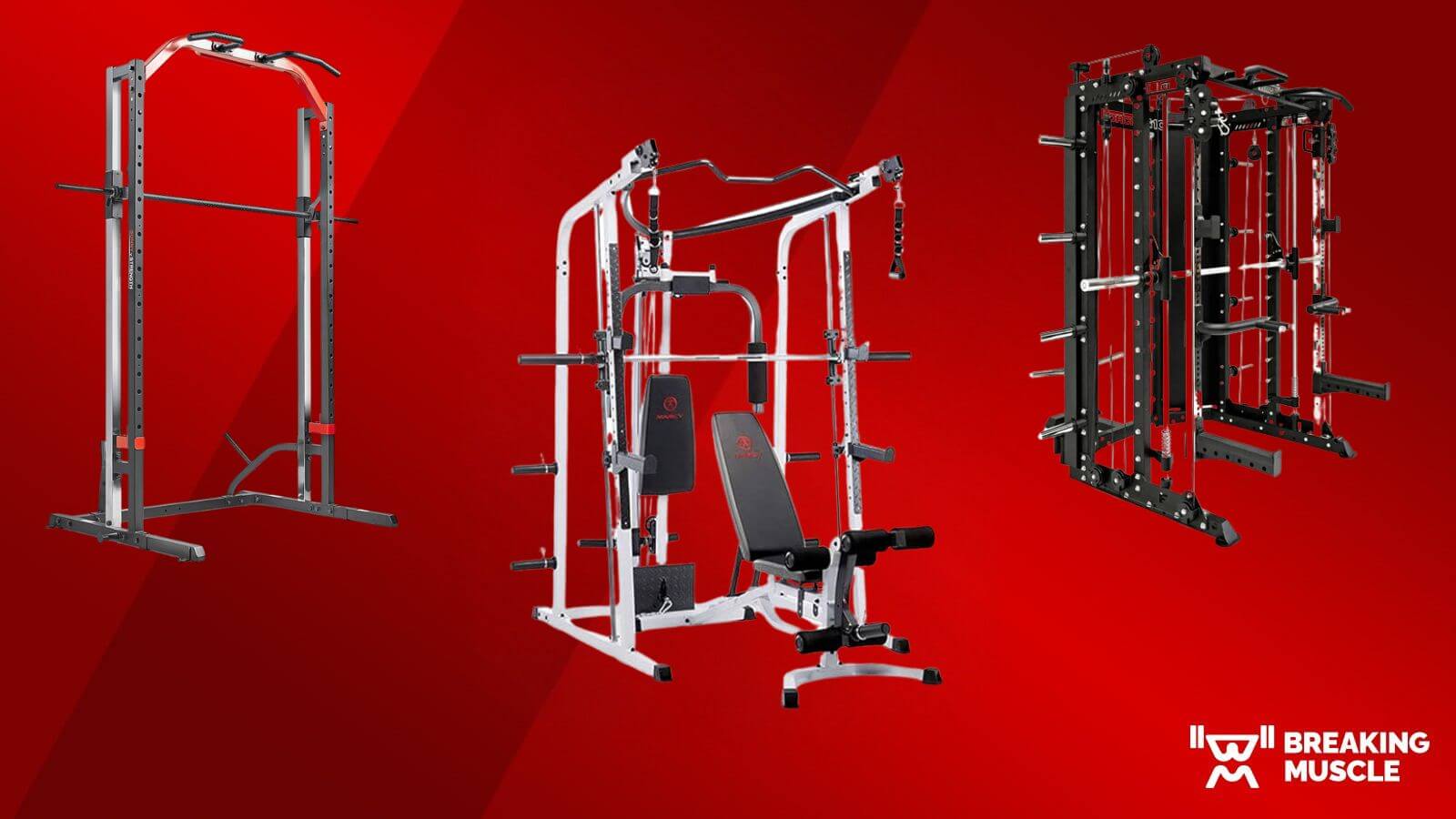
The pursuit of personal fitness has undergone a profound transformation, with the home gym evolving from a niche luxury to a mainstream necessity. Amidst this shift, the Smith machine, once predominantly a fixture in commercial fitness centers, has emerged as a cornerstone of the modern home workout space. Recognized for its unparalleled versatility and inherent safety features, this piece of equipment caters to lifters across all experience levels, offering a robust platform for muscle building and strength development without the need for an external spotter.
The Enduring Legacy: A Brief History of the Smith Machine
The concept of a guided barbell system dates back to the mid-20th century. Attributed to Rudy Smith, who managed a gym in New Jersey in the 1950s, the machine was initially designed to offer a safer alternative for lifters training alone. Smith adapted an existing apparatus, and his innovations ultimately led to the widespread adoption of what became known as the Smith machine. Its core design — a barbell fixed within steel rails, allowing only vertical or slightly angled movement, often with adjustable safety catches — revolutionized strength training by providing a controlled environment. This design addressed a critical need: the ability to perform heavy compound lifts like bench presses and squats without the inherent risks associated with free weights, particularly for solo practitioners or those recovering from injuries.
Over the decades, the Smith machine has continuously evolved. Early models were simplistic, focusing solely on the guided bar path. Modern iterations, particularly those designed for home use, have integrated an array of functionalities, transforming them into comprehensive all-in-one training solutions that combine the Smith system with power racks, cable machines, and various attachments. This evolution directly reflects the changing demands of the fitness landscape, where space efficiency and multi-functionality are paramount for home gym enthusiasts.
The Rise of the Home Gym and the Smith Machine’s Pivotal Role
The surge in home gym popularity, significantly accelerated by global events in recent years, has fueled demand for robust and versatile equipment that mirrors commercial gym capabilities. Consumers are increasingly seeking solutions that offer a complete workout experience within limited residential spaces. The Smith machine, with its capacity for numerous exercises and its integrated safety mechanisms, fits this requirement perfectly. It provides the added protection crucial for exercises such as bench presses, back squats, and deadlifts, mitigating the need for a spotter and empowering individuals to push their limits safely. This makes it a discerning investment for those aspiring to build a comprehensive garage gym or a dedicated workout corner.
Mauro S. Maietta, district fitness and education manager for Crunch Fitness, emphasizes the inherent advantages: “The Smith machine helps the athlete feel supported and gives them greater control and stability when performing an exercise.” This controlled environment is particularly beneficial for new lifters, allowing them to concentrate on mastering proper form without the added complexity of stabilizing a free barbell. Dr. Christopher Mohr, PhD, RD, echoes this sentiment, stating, “Maintaining correct form is important for avoiding injuries and maximizing the effectiveness of your workouts. Beginners might benefit from working with a personal trainer initially or taking a beginner class to learn proper techniques.”
Beyond beginners, the Smith machine also serves as a valuable tool for injury rehabilitation. Its guided motion and inherent stability provide a safer means to rebuild strength and improve joint stability, offering a progressive pathway back to free weights. Maietta advises starting with lighter weights to acclimate to the machine’s fixed range of motion, cautioning users to “listen to your body and joints if you feel any discomfort or pain during the planned movements,” as the fixed path may not suit everyone.
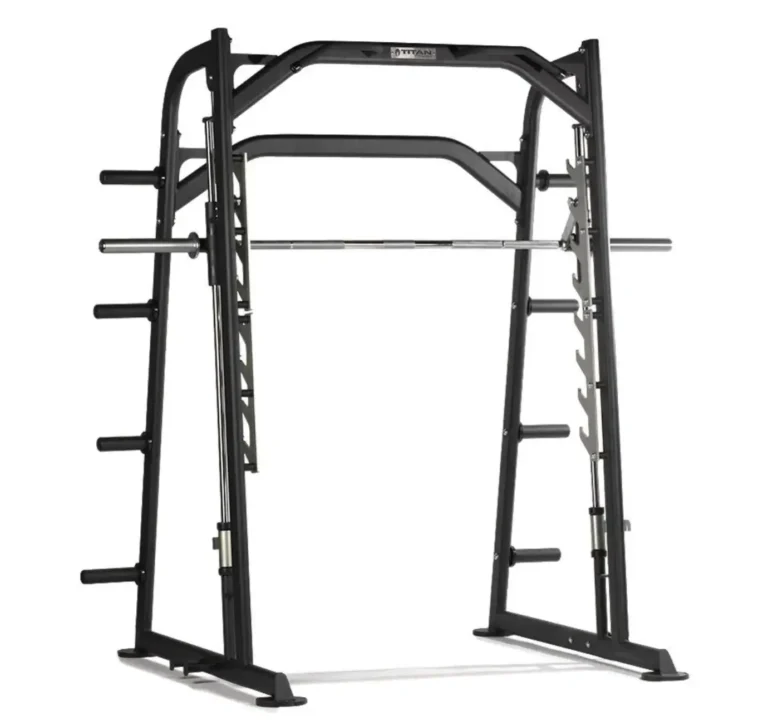
Furthermore, the "spotter" function of a Smith machine allows individuals to safely implement progressive overload, a fundamental principle for increasing muscle size and strength. Mohr notes that "this continual challenge helps your muscles grow stronger. It’s important to start with manageable increments to prevent injury." The ability to easily rack the bar or set safety stoppers at precise points offers an unparalleled sense of security for solo training.
Unlocking Comprehensive Training: The Versatility of the Smith Machine
The Smith machine’s reputation as the "Swiss army knife of the weight room," as described by Maietta, stems from its remarkable versatility. It accommodates a vast array of strength training exercises within its fixed vertical or angled path. From various squat and lunge variations for leg day to bench press and overhead press movements for chest and shoulders, the machine allows for targeted muscle development. High-end models, particularly all-in-one trainers, expand this versatility further by incorporating cable systems, enabling exercises like cable crossovers, chest flys, and overhead triceps extensions. This multi-functional capacity allows users to perform full-body workouts efficiently within a single footprint.
Rigorous Evaluation: Our Methodology for Identifying Top Smith Machines
As Smith machines have gained traction within the home gym community, our team of expert product testers has intensified its evaluation efforts. Our comprehensive assessment process meticulously examines various critical factors that collectively shape the user experience and overall value. This rigorous due diligence involves not only analyzing product specifications but also hands-on testing to separate the elite from the merely adequate.
Our 1-5 scoring system considers:
- Build Materials and Construction: The quality of steel, welding, powder coating, and moving parts significantly impacts durability and stability. We assess the gauge of steel, the type of bearings or bushings used for the bar path, and the overall craftsmanship.
- Bar Path Smoothness: A smooth, consistent bar path is crucial for effective and safe lifting. Testers evaluate friction, resistance, and any sticking points throughout the bar’s range of motion.
- Versatility and Functionality: This includes the range of exercises that can be performed, the inclusion of additional stations (e.g., cable pulleys, pull-up bars, power rack functionality), and compatibility with attachments.
- Safety Features: The efficacy and ease of use of safety catches, stoppers, and re-racking mechanisms are paramount.
- Footprint and Size: How much space the machine occupies, particularly relevant for home gym environments.
- Value for Money: A comprehensive assessment of price versus features, durability, warranty, and overall user experience.
- Assembly Complexity: The time and effort required for setup, with consideration for professional assembly options.
- Knurling Quality: The grip provided by the barbell’s knurling is vital for heavy lifts.
- Warranty and Customer Experience: The length and terms of the warranty, return policies, and customer support responsiveness.
Through this meticulous process, our team has narrowed down the extensive market offerings to a select few, representing the pinnacle of Smith machine innovation and performance for 2025.
Featured Selections: Top Smith Machines for 2025
Best All-in-One Smith Machine: Force USA G15 All-in-One Trainer
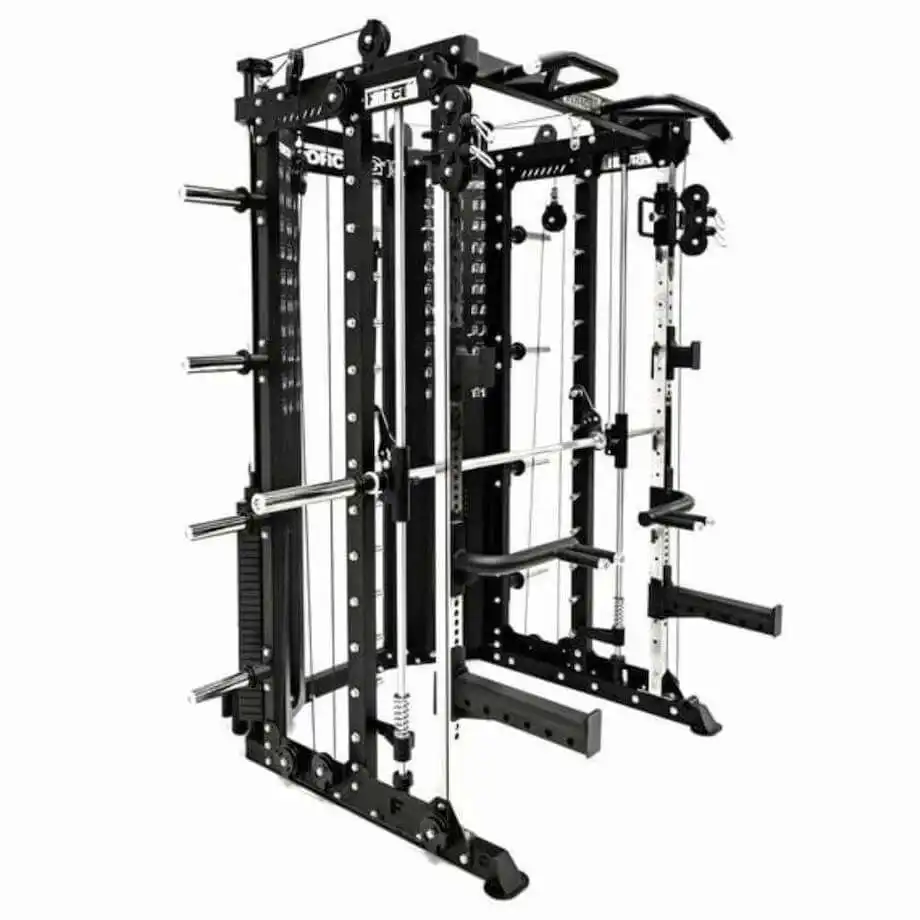
The Force USA G15 All-in-One Trainer stands as a testament to multi-functional excellence, designed for serious lifters seeking a comprehensive home gym solution. With a price point around $5,500, it represents a significant investment, yet its 4.5 out of 5 stars for versatility from our lead product tester underscores its capability to facilitate an expansive array of exercises. The G15 integrates a functional trainer, half rack, and Smith machine into a single, robust unit, weighing nearly 1,000 pounds. This substantial construction contributes to its 4 out of 5 stars for durability and construction, with our tester describing it as "like a tank," noting its immovable stability once assembled.
Measuring over 6 feet wide, 4 feet deep, and 7 feet tall, the G15 earns a 4-star footprint rating. While not the most compact option available, its ability to consolidate multiple pieces of equipment into one unit makes it a space-efficient choice for its extensive functionality. Dual 289-pound weight stacks ensure its stability.
A notable feature is its adjustable pulley ratio, allowing users to switch between 2:1 and 4:1, effectively halving or quartering the perceived weight. While our tester expressed a preference for a 1:1 ratio for maximum resistance, the available ratios are deemed "adequate for most people working out from home."
The G15 includes a generous suite of attachments: J-hooks, safety spotter arms, multi-grip dip handles, a multi-grip pull-up bar, band pegs, and a low row footplate. An optional $700 upgrade kit further expands its capabilities with additional strength training stations, functional attachments, a TV mount, and storage shelves, truly making it a central hub for any home gym.
However, the G15 does present some drawbacks. Our tester noted that the cable pulleys, made of nylon rather than aluminum, lacked optimal smoothness and long-term durability compared to metal alternatives. Assembly is also a considerable undertaking, with an estimated "at least 20 man hours" required, and professional installation costing an additional $800. Furthermore, despite its premium price, the built-in barbell’s knurling was described as "super passive," potentially compromising grip during heavy Smith machine movements. This, combined with the material choice for the pulleys, contributed to a 3.5 out of 5 stars for value.
Value-Driven All-in-One: Titan Fitness Smith Machine
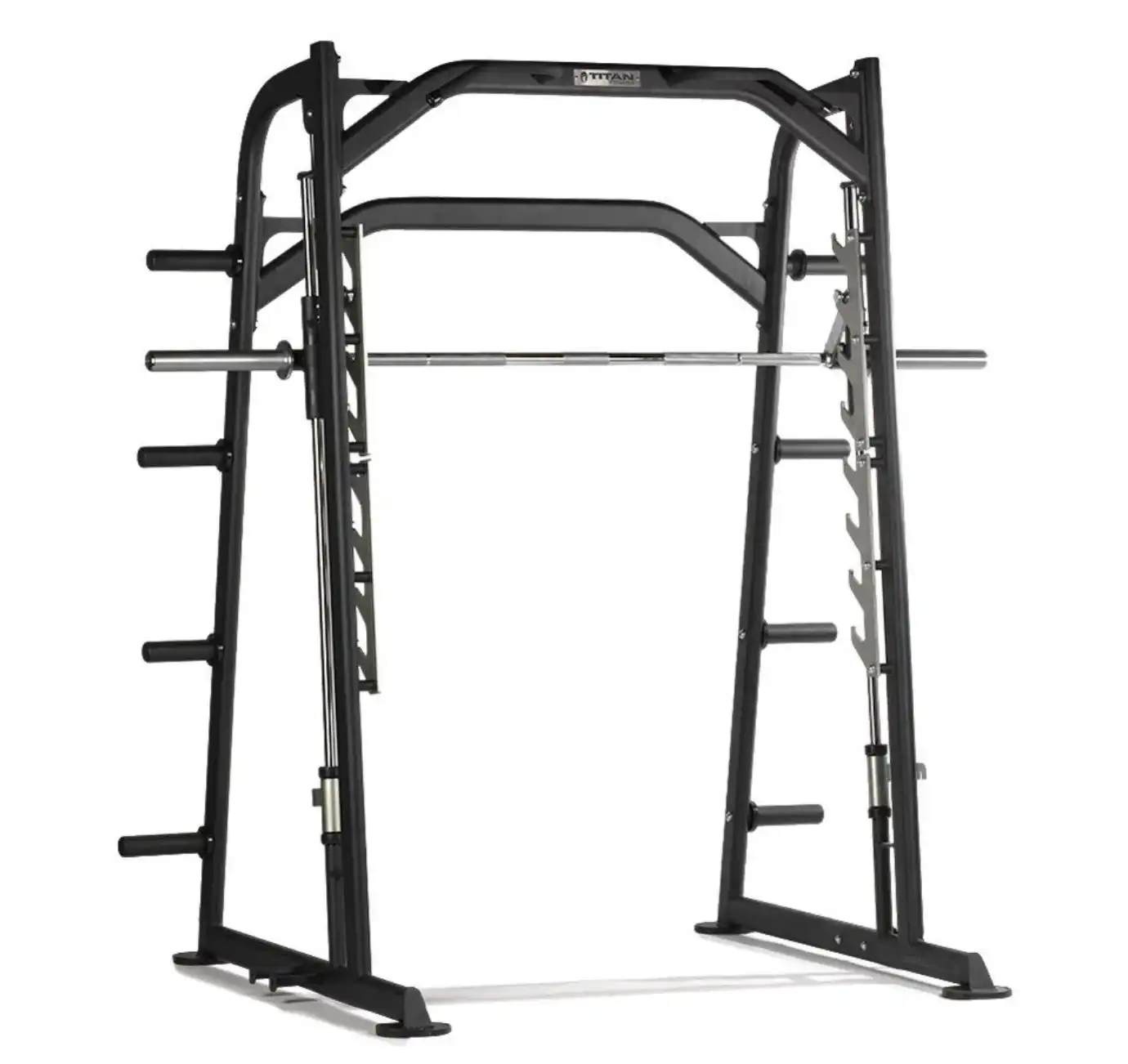
For those seeking an all-in-one workout solution at a more accessible price point, the Titan Fitness Smith Machine offers compelling value. Priced at approximately $1,700, it provides an excellent workout experience for less than a third of the G15’s cost. Our seasoned product tester lauded its smooth barbell glide and angled design, which she found enhanced muscle activation during lower-body exercises such as squats and lunges. The machine’s counterbalanced barbell, reducing the effective weight of the 45-pound bar to just 15 pounds, is a significant benefit for beginners.
While the knurling on the Titan Smith machine was deemed acceptable for a Smith machine, it did not impress our team as a "grippy bar." Nonetheless, its ergonomics received high marks, earning a 4 out of 5 stars rating. Crucially, the machine’s stability was a standout feature, achieving a perfect 5 out of 5 rating. Our tester affirmed, "This is a super stable machine; there was no give to it even when we were using heavy weights. This was ultra-smooth."
The primary detraction for the Titan Fitness Smith Machine is its warranty and customer experience. A one-year warranty is considered subpar for fitness equipment of this nature, falling short of industry expectations. Additionally, the return policy, which requires customers to cover return shipping costs and a 20% restocking fee, led to a disappointing 2 out of 5 stars for customer experience.
Best Compact Smith Machine Attachment: Bolt Fitness Supply Storm Series Stinger Attachment
For home gym owners with existing power or squat racks, the Bolt Fitness Supply Storm Series Stinger Smith Machine Attachment offers a brilliant space-saving solution. This universal attachment, compatible with any 3” x 3” frame using 1” hardware, seamlessly converts a rack into a highly functional Smith machine, expanding training possibilities without requiring a dedicated standalone unit. Its versatility is rated at 4.5 out of 5, owing to 12 different vertical adjustment positions spanning 60 inches, allowing for rapid transitions between exercises like incline bench presses and Romanian deadlifts. The integrated 43-inch multi-grip pull-up bar further enhances its utility for vertical pulling strength.
Bolt Fitness Supply earns solid marks for construction, with 4 out of 5 stars. However, our chief product tester noted that the craftsmanship, particularly in welds and powder coats, may not match the premium finish of industry leaders like Rogue or REP. Similar to other reviewed products, the Smith bar’s knurling was a point of criticism, described as passive and inadequate for heavy lifting, leading our tester to state, "You definitely won’t mistake this for an Olympic barbell."
At approximately $1,100, the Stinger Attachment is positioned on the higher end for a rack attachment, especially when compared to options like the Bells of Steel Smith Machine Rack Attachment, priced around $800. This pricing, coupled with the prerequisite of owning an existing rack, resulted in a 3 out of 5 stars for value, suggesting a significant total investment for a fully functional setup.
Best Budget Smith Machine: RitFit Smith Machine
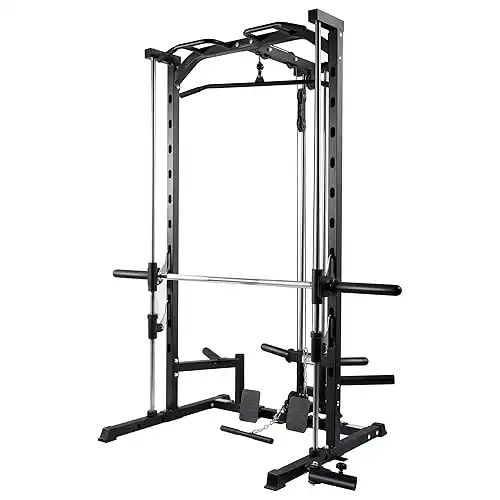
The RitFit Smith Machine stands out as the most affordable option to receive our endorsement, making it an ideal choice for budget-conscious fitness enthusiasts. Priced at approximately $500 on Amazon, it offers significant financial accessibility, costing less than a third of the Titan Fitness Smith Machine and less than a tenth of the Force USA G15. Our top product tester dubbed it the "sleeper pick," noting that its "low price covers so many sins." This aggressive pricing earns it a near-perfect value rating of 4.5 out of 5 stars.
Despite its budget classification, the RitFit machine offers commendable versatility, scoring 4 out of 5 stars. It includes built-in low row and lat pulldown capabilities via a plate-loaded cable pulley system with a 165-pound capacity. It also comes with several attachments, including a pin-on landmine row and two multi-purpose pull-up handles. Its compact design and lightweight nature (just 140 pounds) make it highly suitable for home gyms with limited space and easier to reposition than heavier alternatives.
However, the RitFit Smith Machine’s affordability comes with compromises in build quality and stability. Constructed with lighter and cheaper materials, it received 3.5 out of 5 stars for both construction and stability. This indicates it may not be the optimal choice for those planning to lift exceptionally heavy weights. Nevertheless, considering its comprehensive functionality at a price comparable to a high-quality Olympic barbell alone, the RitFit Smith Machine presents a compelling option for those operating within strict budget constraints.
Best Smith Machine Attachment: Bulletproof VTS Lite Rack Attachment

The Bulletproof VTS Lite Rack Attachment introduces an innovative solution for transforming a squat rack into a Smith machine using one’s own barbell. Priced around $700, this product from the lesser-known but increasingly recognized Bulletproof Fitness manufacturer has captured our attention for its ingenious concept and execution. While our team has not yet conducted hands-on testing (with its release slated for May 2025), the design principles and material choices suggest a high-quality offering.
The Versa Trolley System (VTS) Lite employs UHMW plastic for its rollers, a material known for its ultra-durability and smooth operation in other high-performance rack components. This attachment’s light weight of 15 pounds makes it a more user-friendly alternative to the heavier, full-sized VTS model. From a construction standpoint, we confidently assign the VTS Lite 4 out of 5 stars.
A key strength of Bulletproof’s offering is its wide range of compatibility. Users can select from 3” x 3”, 2” x 3”, or 2” x 2” pairs, along with different hook sizes to accommodate various barbell diameters. This level of customization, combined with the expanded exercise variety it provides, earns a 4.5 out of 5 for versatility. Based on its projected price and versatility, the VTS Lite receives a preliminary value rating of 4 out of 5, with potential for an even higher score upon physical review. It promises a streamlined, space- and money-saving alternative to a standalone Smith machine.
Key Factors for Buyers: Making an Informed Decision
Choosing the right Smith machine for a home gym requires careful consideration of several factors beyond just price. Our experience as equipment experts and dedicated lifters highlights the following critical elements:
- Size and Footprint: The physical dimensions of the machine are paramount. Measure your available space meticulously, accounting for not just the machine itself but also clearance for movement, plate loading, and attachment use. All-in-one trainers, while offering multiple functions, can be substantial. Rack attachments are excellent for maximizing space if you already own a compatible rack.
- Other Functions and Integrated Systems: Decide whether you need a standalone Smith machine or a multi-functional unit. Many modern options integrate power rack features, cable functional trainers, low-row stations, chin-up/pull-up bars, dip stations, and even suspension trainer anchor points. The more functions, the higher the initial cost, but potentially greater long-term value and space saving.
- Weight Ratio (for Cable Systems): For machines with integrated cable pulleys, understanding the weight ratio is crucial. A 1:1 ratio means the loaded weight is the actual resistance. A 2:1 ratio means you lift half the loaded weight (e.g., 100 lbs loaded feels like 50 lbs). Some advanced machines offer switchable ratios (e.g., 2:1 and 4:1), which can be beneficial for varying strength levels or for specific exercises requiring lighter resistance. While 1:1 offers the most direct resistance, higher ratios can make cable movements smoother and extend cable travel.
- Weight Capacity: Confirm that the machine’s maximum weight capacity for the Smith bar, rack j-hooks (if applicable), and cable systems can safely accommodate your current and projected lifting goals. Capacities on our list start at 300 pounds for the Smith bar, but can exceed 700 pounds for heavy-duty models.
- Build Quality and Materials: Look for heavy-gauge steel (e.g., 11-gauge for robust frames), smooth-gliding linear bearings or bushings for the Smith bar, and high-quality powder coating to prevent rust and wear. Components like cable pulleys should ideally be aluminum for durability and smooth operation, though nylon can be acceptable on budget models.
- Barbell Quality and Knurling: Pay attention to the integrated Smith bar. Is it Olympic-sized (2-inch sleeves) to accommodate standard plates? How is the knurling? Passive knurling might be adequate for beginners or lighter weights, but aggressive knurling is preferred for maintaining grip during heavy lifts.
- Assembly Requirements: Consider your comfort level with complex assembly. Some all-in-one units can require 20+ hours of assembly time, potentially necessitating professional installation, which adds to the overall cost.
- Warranty and Customer Support: A robust warranty (e.g., lifetime on frame, 10+ years on parts) signals manufacturer confidence in product durability. Research the brand’s reputation for customer service, return policies, and availability of replacement parts.
The Future of Home Fitness: Broad Implications
The evolution and increasing accessibility of advanced home gym equipment like the Smith machine represent a significant stride in the democratization of fitness. No longer is comprehensive strength training confined to commercial establishments. Individuals now have the power to curate personalized, safe, and highly effective workout environments within their own homes. This shift empowers more people to engage in consistent physical activity, fostering healthier lifestyles and greater autonomy over their fitness journeys.
As technology continues to advance, we can anticipate even more integrated, "smart" features within home gym equipment, further blurring the lines between commercial and residential setups. The Smith machine, with its proven track record of safety and versatility, is poised to remain a central figure in this evolving landscape, adapting to new demands and continuing to serve as a reliable partner in the pursuit of strength and well-being.
Smith Machine FAQs
Are there different types of Smith machines?
Yes, Smith machines vary in design and functionality. While all offer a guided bar path, some provide a strictly vertical motion, while others feature a slight angle, which some users find more natural for certain movements like squats. Beyond the bar path, machines can be standalone units focused solely on the Smith function, or they can be integrated into all-in-one trainers that include power racks, functional trainers, pull-up bars, and various attachments, significantly expanding their exercise capabilities. Manufacturers also differentiate their models through build materials, safety features, and integrated technologies.
Can I deadlift on a Smith machine?
Yes, deadlifts can be performed on a Smith machine, but whether it is advisable depends on an individual’s specific goals, skill level, and physical condition. Mauro Maietta suggests considering one’s range of motion, proper form, and mobility before attempting compound movements like deadlifts on a Smith machine. The fixed bar path of a Smith machine can alter the biomechanics of a traditional deadlift, potentially placing different stresses on the body compared to free weights. For beginners or those with mobility concerns, it can be a safer way to practice the movement pattern with controlled weight. However, for advanced lifters aiming to develop true functional strength and stability, free-weight deadlifts are generally preferred. Consulting a fitness professional is highly recommended to ensure proper form and to determine if Smith machine deadlifts align with your training objectives.
Can you build muscle with a Smith machine?
Absolutely, you can effectively build muscle with consistent use of a Smith machine. Its fixed range of motion allows for targeted muscle engagement, making it an excellent option for beginners to focus on form and for experienced lifters to perform isolation exercises or train to failure safely without a spotter. The ability to easily rack the weight and implement progressive overload — gradually increasing the weight, reps, or sets over time — is fundamental for muscle growth. While some experts advocate for free weights for sports-specific muscle building due to the need for greater stabilization, the Smith machine provides a highly effective environment for hypertrophy and strength development.
Is it okay to squat on a Smith machine?
Yes, squatting on a Smith machine is a common and acceptable practice, particularly due to its inherent safety features like hooks and stoppers that provide extra protection. For individuals new to squatting, the guided path can help in learning proper depth and form without the added challenge of balancing a free barbell. It can also be beneficial for those working around injuries or focusing on specific muscle groups. However, it’s important to be mindful of your abilities. The fixed path can alter the natural movement pattern of a free-weight squat, which might not be ideal for everyone. Some users find the fixed path can place unusual stress on the knees or back if not performed with careful consideration of foot placement and body mechanics. As always, if you are unsure about proper technique or safety, consult with a qualified fitness professional.